


Revenue can make a business look successful, but revenue alone does not tell the full story. A company can generate impressive sales, attract more customers, and even experience rapid growth while still struggling financially. This is why business owners need to look beyond revenue and understand the numbers that reveal what is actually happening inside the business. One of the most important of these numbers is net profit margin. If gross margin helps you understand what remains after the direct costs of producing or delivering your products or services, net profit margin takes the analysis one step further. It helps you understand what percentage of your revenue remains after all of your business expenses have been taken into account.

What Is Net Profit Margin?
Net profit margin is a financial measurement that shows the percentage of a company’s revenue that remains as net profit after all expenses have been deducted. In simple terms, it answers an important question: After the business pays all of its expenses, how much money is actually left from every dollar, euro, franc, or pound it earns? This makes net profit margin particularly useful for business owners because it moves the conversation away from simply asking how much money a business is making in sales and toward understanding how efficiently that revenue is being converted into actual profit.
For example, imagine that a business generates $100,000 in revenue during a particular period. After paying for the products it sells, salaries, rent, utilities, marketing, software, transportation, interest, taxes, and other applicable expenses, the business is left with $10,000 in net profit. Its net profit margin would therefore be 10%. In other words, for every $1 the business generated in revenue, approximately $0.10 remained as net profit after the relevant expenses were accounted for.
This is why net profit margin is such an important number for business owners, managers, investors, and other stakeholders. Revenue tells you how much money came into the business. Net profit tells you what remained after expenses. Net profit margin connects those two figures and gives you a percentage that can make financial performance easier to understand and compare.
Why Revenue Alone Can Be Misleading
One of the most common mistakes business owners make is assuming that high revenue automatically means a healthy business. It does not. Revenue is important, but it is only one part of the financial picture. Imagine two businesses that each generate $500,000 in annual revenue. At first glance, they appear to be performing equally. However, Business A spends $450,000 to operate and ends the year with $50,000 in net profit. Business B spends $490,000 and ends the year with only $10,000 in net profit. Both businesses generated the same revenue, but their financial performance is very different.
This is where the statement that “revenue is a vanity metric, but margin is sanity” becomes useful. The phrase should not be interpreted as meaning that revenue is unimportant. Revenue is absolutely important because a business needs sales to generate income. The point is that revenue by itself can create an incomplete picture. A business should not only ask how much it is selling. It should also ask how much it is retaining after the costs and expenses required to generate those sales.
A company that increases revenue by 30% but sees its net profit margin fall significantly may need to investigate what is driving the additional costs. Perhaps it reduced prices to attract customers. Perhaps supplier costs increased. Perhaps payroll increased faster than revenue. Perhaps marketing expenses grew without producing sufficient returns. Perhaps administrative costs have become too high. Looking at net profit margin can help bring these issues into focus.
Net Profit Margin Formula
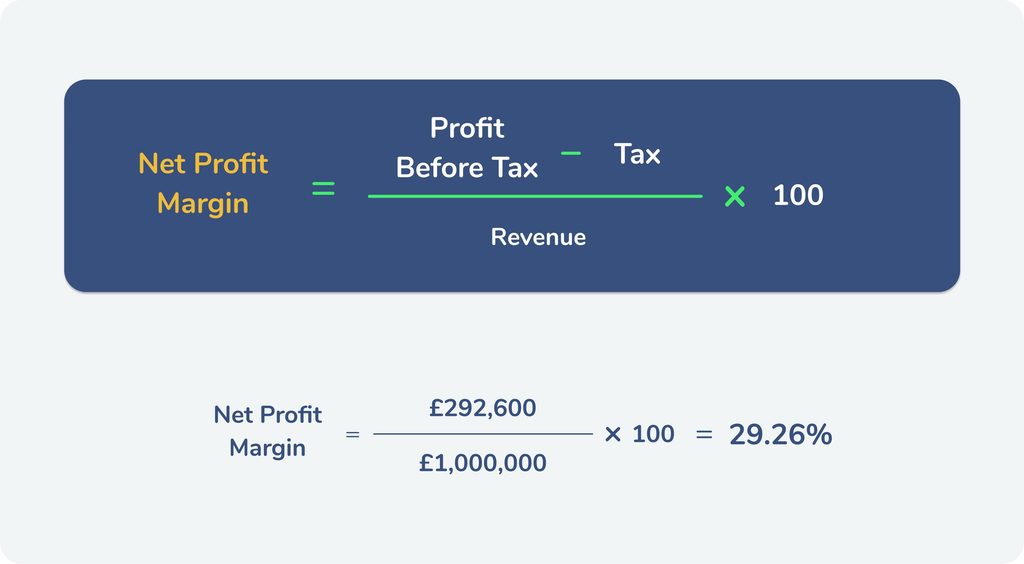
The basic net profit margin formula is straightforward:
Net Profit Margin = Net Profit ÷ Revenue × 100
For example, suppose your business generates $200,000 in revenue and records $30,000 in net profit after applicable expenses.
The calculation would be
$30,000 ÷ $200,000 × 100 = 15%
Therefore, the business has a 15% net profit margin.
This means that after accounting for the expenses included in the calculation, the business retained approximately $0.15 in net profit for every $1 of revenue.
The formula itself is simple. The challenge for many businesses is ensuring that the underlying financial information is accurate and complete. If expenses are missing, transactions are incorrectly categorized or financial records are not properly maintained, the resulting net profit margin may not accurately represent the company’s actual financial position.
What Goes Into Net Profit?
To understand net profit margin, you first need to understand net profit. Net profit is generally the amount remaining after the applicable business expenses have been deducted from revenue. Depending on the business and accounting method, these expenses can include direct costs, operating expenses, salaries, rent, utilities, technology expenses, marketing costs, interest, and taxes, among other expenses.
This is one reason bookkeeping matters so much. If a business does not consistently record its income and expenses, it becomes difficult to determine whether the reported profit is reliable. A business owner may look at the bank balance and assume the company is profitable, but a bank balance and net profit are not the same thing. Cash may have entered the account for reasons that do not represent operating revenue, and expenses may not yet have been paid even though they relate to the period being analyzed.
Accurate financial records provide the foundation for meaningful financial analysis. When the underlying records are incomplete, the calculations built on top of them can also become unreliable.
Gross Margin vs. Net Profit Margin
This is where many business owners become confused. Gross margin and net profit margin are both useful, but they answer different questions.
Gross margin focuses on what remains after subtracting the direct costs associated with producing or delivering the goods or services sold. It gives you insight into the economics of what you are selling before broader operating expenses are considered.
Net profit margin goes further. It looks at what remains after the applicable expenses have been accounted for.
Consider a simple example. Suppose a business generates $100,000 in revenue and has $60,000 in direct costs. That leaves $40,000 in gross profit, resulting in a 40% gross margin. However, the business may still have $30,000 in additional operating and other expenses. If those expenses leave the business with $10,000 in net profit, its net profit margin would be 10%.
This distinction is critical. A business could have a healthy gross margin but a weak net profit margin because its operating expenses are too high. That is why looking at gross margin alone is not enough.
Gross margin helps answer: Are we making enough from what we sell after direct costs?
Net profit margin helps answer: After all relevant expenses, how much of our revenue are we actually keeping as profit?
Both measurements provide valuable information.

Why Net Profit Margin Matters to Small Businesses
Net profit margin is particularly important for small businesses because owners often have limited resources and need to make decisions carefully. A business may be growing, but growth can become expensive. Additional employees, larger premises, more software subscriptions, higher advertising budgets, transportation costs, and increased administrative requirements can all affect profitability.
Monitoring net profit margin allows business owners to see whether growth is translating into stronger financial performance. If revenue increases while net profit margin remains stable or improves, that may indicate that the business is managing its costs effectively. If revenue increases while net profit margin consistently declines, the business may need to investigate what is happening.
This does not necessarily mean that a declining margin is automatically a crisis. Businesses sometimes deliberately accept lower margins during periods of expansion, investment, or market entry. The important thing is that the business owner understands what is happening and why.
The danger comes when the owner does not know.
A Growing Business Can Still Have a Margin Problem
Growth is often celebrated, and rightly so. More customers, more sales, and a larger market presence can be signs that a company is moving in the right direction. But growth without financial discipline can create problems.
Imagine a business that doubles its revenue from $100,000 to $200,000. That sounds excellent. However, suppose its net profit only increases from $15,000 to $16,000. Revenue doubled, but profit barely changed. The business is doing more work and generating significantly more sales without producing a proportional increase in profit.
This is why business owners should ask more than, “Are we growing?”
They should also ask:
“Is our growth profitable?”
That is a much more useful question.
What Is a Good Net Profit Margin?
There is no universal net profit margin that can be classified as “good” for every business. Profit margins can vary significantly depending on the industry, business model, location, company size, pricing structure, operating costs, and stage of growth.
A professional services company may have a very different margin structure from a retail business. A technology company may have different economics from a restaurant. A startup investing heavily in growth may intentionally operate with low or negative profit margins during an early stage.
For this reason, business owners should be careful about comparing their net profit margin with a random percentage found online and immediately concluding that their business is performing badly.
A better approach is to understand your own margin over time, compare it with relevant industry benchmarks when reliable data is available, and investigate meaningful changes in your financial performance.
The key question is not simply whether your margin is high or low. It is whether the margin is appropriate for your business model and whether it is moving in a direction that supports your business objectives.

What Can Cause Net Profit Margin to Fall?
There are many reasons why a company’s net profit margin can decline. Sometimes the problem is related to pricing. If prices remain unchanged while costs increase, the business may retain less profit from every sale. In other situations, the issue may be operating expenses. Hiring too quickly, increasing office costs, subscribing to unnecessary software, or spending heavily on marketing without measuring results can all put pressure on profitability.
Supplier costs can also have a significant impact. Businesses that depend on materials, inventory, or external services may experience changes in their cost structure. If those increases are not reflected in pricing or managed through efficiency improvements, margins can become smaller.
Discounting is another factor. Discounts can be useful as part of a deliberate sales strategy, but frequent or excessive discounting can reduce the amount of profit generated from each transaction.
Poor financial management can also contribute to the problem. If business owners do not regularly review their income and expenses, they may not notice that certain costs are increasing until the impact becomes significant.
How Can a Business Improve Its Net Profit Margin?
Improving net profit margin does not always mean simply cutting costs. In fact, indiscriminate cost-cutting can sometimes damage a business. The goal should be to improve the relationship between revenue and the expenses required to generate that revenue.
One approach is to review pricing. If the cost of delivering a product or service has increased significantly, prices may need to be reassessed. Pricing decisions should consider the value provided to customers, competitive conditions, and the actual cost structure of the business.
Another approach is to understand which products or services generate the strongest margins. Not every sale contributes equally to profitability. Some products may generate significant revenue but relatively little profit, while another service may produce less revenue but substantially higher margins.
Businesses can also review recurring expenses. Software subscriptions, advertising expenses, office costs, professional fees, and other recurring charges should periodically be evaluated to determine whether they are still delivering sufficient value.
Improving operational efficiency can also help. Technology, better processes, staff training, and clearer workflows can reduce wasted time and resources.
Most importantly, business owners need accurate financial information. You cannot effectively improve a number you cannot reliably measure.
Net Profit Margin and Better Business Decisions
Financial ratios become valuable when they influence decisions. Knowing your net profit margin is not useful simply because you can put a percentage into a spreadsheet. The real value comes from understanding what the percentage is telling you.
Suppose your net profit margin falls from 18% to 11%. That change should prompt questions. What happened? Did revenue fall? Did supplier costs increase? Did payroll increase? Did marketing expenses rise? Did the business take on new debt? Were there unexpected expenses? Was a particular product or service less profitable than expected?
The percentage is the starting point for the conversation.
This is why financial reporting should not simply produce numbers. It should help business owners understand the story behind those numbers.
Why Consistent Bookkeeping Matters
You cannot calculate a meaningful net profit margin if your financial records are incomplete. This is one of the reasons consistent bookkeeping is so important.
Waiting until the end of the year to organize financial records can make it much harder to understand what is happening in the business throughout the year. Regular bookkeeping gives business owners an opportunity to identify trends earlier, monitor expenses, and make decisions based on current information.
The CaTts approach to financial education should therefore go beyond simply teaching business owners formulas. The bigger goal is to help them understand how financial information can support better decisions.
A business owner should be able to look at their financial reports and understand what the numbers are saying.
Net Profit Margin Is Not the Same as Cash Flow
Another important distinction is the difference between profitability and cash flow. A business can report a profit while experiencing cash flow difficulties. This can happen for various reasons, including the timing of customer payments, debt obligations, inventory purchases, and other cash movements.
Similarly, having money in a bank account does not automatically mean that the business has generated a corresponding amount of net profit.
This is why business owners should avoid relying on a single financial number. Revenue, gross profit, net profit, margins, and cash flow all provide different pieces of the financial picture.
Understanding these distinctions can help business owners avoid making decisions based on assumptions rather than evidence.
The Bottom Line: Making Money Is Not the Same as Keeping Money
The biggest lesson behind net profit margin is simple.
Making sales is not the same as making profit.
And making profit is not the same as understanding how efficiently the business is operating.
Revenue tells you how much your business generated from sales. Gross profit helps you understand what remains after direct costs. Net profit tells you what remains after the applicable expenses have been accounted for. Net profit margin then expresses that remaining profit as a percentage of revenue.
That percentage can become an important indicator of the financial health and efficiency of a business.
So the next time you look at your business revenue, don’t stop there.
Ask yourself:
How much did we sell?
Then ask:
How much did it cost us to generate those sales?
And finally:
After everything was accounted for, how much did we actually keep?
That final question is where net profit margin becomes particularly valuable.
Frequently Asked Questions About Net Profit Margin
What is net profit margin in simple terms?
Net profit margin is the percentage of revenue a business keeps as net profit after the applicable expenses have been deducted. If a business has a 10% net profit margin, it means that $10 of net profit remains for every $100 of revenue, based on the figures included in the calculation.
How do you calculate net profit margin?
The basic formula is Net Profit Margin = Net Profit ÷ Revenue × 100. For example, if a business generates $100,000 in revenue and has $15,000 in net profit, its net profit margin is 15%.
What is the difference between gross margin and net profit margin?
Gross margin focuses on the profit remaining after direct costs associated with producing or delivering goods or services are deducted. Net profit margin goes further by considering the broader expenses included in the net profit calculation. Therefore, a business can have a strong gross margin but a much lower net profit margin.
Is a higher net profit margin always better?
Generally, a higher margin means the business is retaining more profit relative to revenue, but context matters. Different industries have different margin structures, and a company may deliberately accept lower margins while investing in growth. Business owners should consider their industry, business model, objectives, and margin trends.
Why is my net profit margin decreasing while revenue is increasing?
This can happen when expenses or direct costs are increasing faster than revenue. Possible causes include higher supplier costs, increased payroll, excessive discounting, rising marketing expenses, inefficient operations, or other growing expenses. The financial statements should be reviewed to identify the specific cause.
How often should a business review its net profit margin?
The appropriate frequency depends on the business, but reviewing financial performance regularly can help identify trends earlier than waiting until the end of the year. Monthly financial reviews are often useful for businesses that have sufficient financial records and reporting systems.
Can a business have high revenue but low net profit?
Yes. High revenue does not guarantee high profit. A business can generate substantial sales while spending a large amount on direct costs and operating expenses. This is why business owners should evaluate revenue alongside profitability and margins.
Final Thought
Revenue gets attention. Profit keeps the business alive. Margin helps you understand the relationship between the two.
Understanding net profit margin is not about becoming an accountant overnight. It is about becoming a more informed business owner.
When you know your numbers, you can ask better questions. When you ask better questions, you can make better decisions. And when financial decisions are based on reliable information rather than assumptions, your business has a stronger foundation for sustainable growth.
CATTS Business Solutions believes financial knowledge should be understandable, practical, and useful.
The numbers in your financial statements are not just numbers.
They are telling you a story about your business. Learn to read it.

